

envitron systems GmbH
Snow load
Never underestimate the weight of snow and ice on your roof.
At risk
Is your roof still safe?
The snow load on roofs still gets too little attention. The collapse of the ice rink in Bad Reichenhall in 2006 was only a tragic beginning - many more incidents were to follow.
The actual snow load does not depend on snow depth alone. What matters most is the type of the individual snow layers: the weight varies significantly between ice, wet snow and powder snow. Add to that rain and melt water. Extreme weather events keep increasing - and so do the risks of excessive roof loads.
Buildings with older structures or with additional loads - for example from photovoltaic systems - are particularly at risk.
What 10 centimetres of snow really weigh.
Not all snow is equal. The density decides - and with it the weight per square metre.
-
10 kg/m²
Fresh powder snow
At 10 cm of dry fresh snow - the light case.
-
40 kg/m²
Wet snow
At 10 cm of a wet layer - four times the load.
-
× multiplied
Plus rain, ice, melt water
Mixed loads push the weight up further - quickly and unnoticed.
What you need to know about snow load.
Three points every flat-roof owner should know.
-
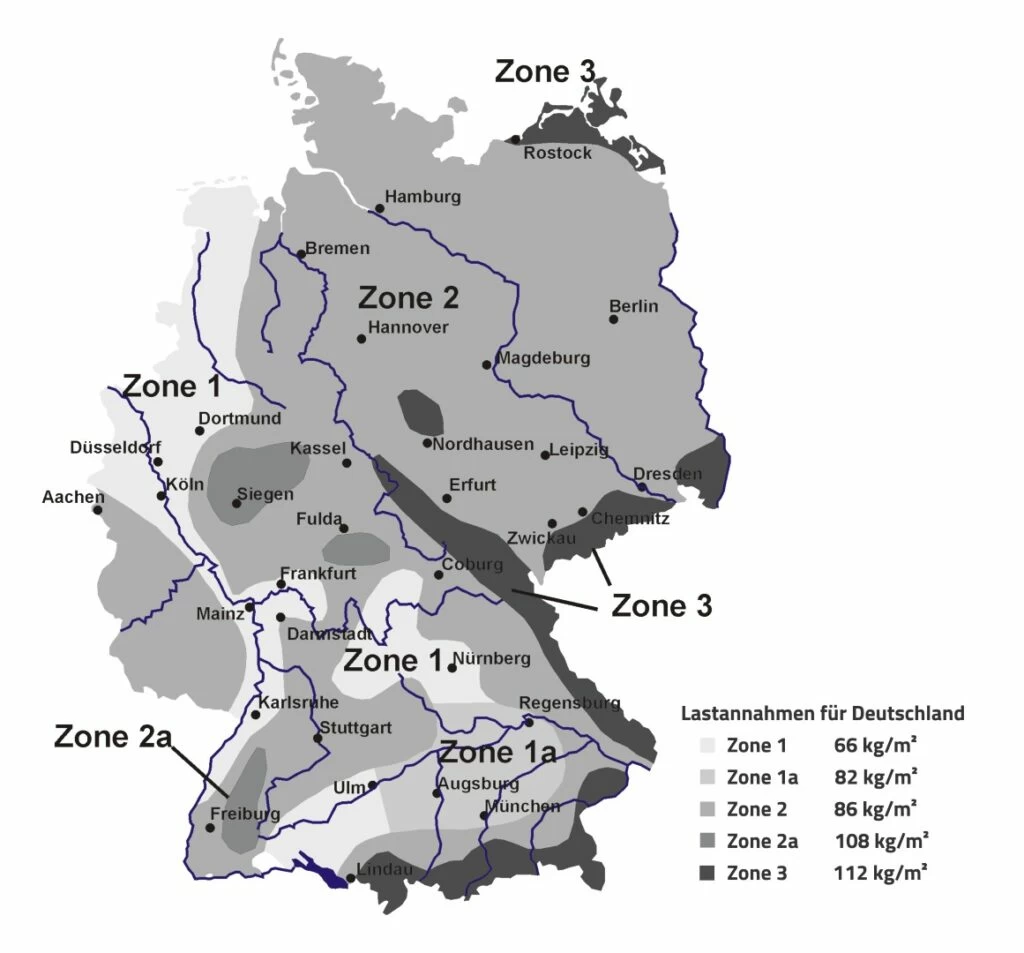
Snow-load zones in Germany
Location is decisive. Germany is divided into five snow-load zones (1, 1a, 2, 2a, 3) according to DIN EN 1991-1-3. Many existing buildings do not meet today's structural requirements - flat roofs with additional PV or technical loads in particular are critical.
-
DGUV recommends continuous monitoring
The German Social Accident Insurance highlights in DGUV Information 212-002 „Schneeräumung auf Dachflächen“ that only a sufficient number of measuring points can realistically reflect the snow-load situation on a flat roof.
-
Continuous monitoring made easy
With the snowcontrol snow-load measuring system, roof load can be monitored conveniently from the desk or smartphone - around the clock, without anyone having to climb on the roof in the snow.
Standard
Snow-load zone map of Germany.
The map per DIN EN 1991-1-3 is the basis for the structural design of every roof in Germany. It shows the characteristic snow load you have to expect at your location - and why a blanket assumption is not enough.
- 1 Zone 1 - lowest load (coastal regions, lowlands)
- 1a Zone 1a - slightly elevated
- 2 Zone 2 - medium load (large parts of Germany)
- 2a Zone 2a - elevated (low-mountain ranges, alpine foothills)
- 3 Zone 3 - highest load (alpine region)
snowcontrol solution
Snow load reliably in view - automatic, anytime.
Multiple sensor points on the roof, wireless transmission, clear analysis in the data portal: threshold alarms via email or SMS, ready-made reports for insurers and surveyors.